this work contains descriptions of violence, cruelty, and acts of human depravity that may be psychologically distressing or shocking. the narrative addresses sensitive and dark themes, including the betrayal by family members and the death of a child. the text may contain strong language or coarse expressions used to enhance the artistic atmosphere and convey the raw emotional state of the characters.
please approach this story with caution. the author does not aim to offend anyone's feelings but intends to tell a story about the collision between pure light and the deepest human darkness. reader discretion is advised. 18+
discord: ohjesusdave
Amalthea was born in the north of Siberia, far beyond Turukhansk, in a small village where the Yenisei no longer looks like a river and turns into something almost oceanic. there is a lot of sky there, a lot of wind, and the taiga around is so dense that if you walk into it without a guide, whatever comes back out is not exactly the same person. she was born on the seventh of july, just before dawn, when the light was pale and quiet and the water behind the house lay smooth as tin. she was the third child in the family. her father fished, her mother healed people with herbs, with tinctures, with her hands, and with the old songs she still remembered from her ewenki grandmother. by local standards they lived well. a solid larch house, a boat, nets, a smokehouse, a cellar packed with fish, berries, and roots. it was her father who gave her the name. in winter he liked to look at an old worn out atlas of the sky, given to him long ago by a geologist. that is where he found this strange name, Amalthea. her mother first snorted and said the name was too odd for a siberian village. but then she took the newborn in her arms, looked at her, and agreed. some children fit the local names right away, like felt boots on a foot. this one needed a star. when her mother first unwrapped the swaddling cloth and showed the girl to the midwife, the woman stepped back and was silent for a long time. Amalthea was white. completely white. not pink like normal newborns, not red from crying, but white like the first snow that falls before dawn, while nobody has touched it yet. her hair was white, soft as the down of a snowy owl. her eyebrows were white, nearly invisible, as if someone had drawn them in milk on milk. her eyelashes were white and long, in sunlight they looked transparent, like the thinnest ice needles. when she was carried out onto the porch at twilight, and the northern light touched her head, the white hair began to shimmer with a deep blue, and then it looked as if the girl had not hair on her head but a piece of the night sky. the old women whispered that such a color only appears on children the moon held too long before letting them down to earth. and her eyes. her eyes were grey-blue, the color of northern twilight, with such a dark rim around the iris that she always looked mildly surprised. but the main thing was not the color. the main thing was their clarity. they were so transparent, so pure, that it seemed as if a tiny crystal sat inside each one. as if someone had taken two shards of the clearest mountain quartz and placed them where other people have just a slightly cloudy cornea. when light fell on her face, her eyes flared from within, and people involuntarily looked away, because such purity in a child's eyes seemed abnormal, too perfect for a world where everything is a little dirty. she did not cry from the wind. she did not flinch when in winter the shutters banged as if someone outside was asking to be let in. she lay in the cradle her father had carved from a larch root pulled out by the spring flood, and she looked past faces, into the corner, out the window, into the empty space above the stove. the old women in the village whispered that such children are born when a soul has wandered too long before entering a body.
by the age of two she was speaking so clearly that adults found it frightening. not the way small children usually speak, in fragments and funny half words, but in short, clear sentences. she mixed russian with her mother's old dialect so naturally that it seemed both languages had grown from a single root. she could stand on the porch in her fur socks, look at the fog over the water, and quietly say that today the fish would go deeper because the river was angry. and the fish would go deeper.
at three she already told birds apart by their voices. a seagull from a merganser, a raven from a nutcracker, a loon from a duck, she never mistook one for another. the foxes that came to the edge of the village in winter she called by her own names and insisted it was not one fox but three ers. the youngest limps, the middle one is sly, the oldest never takes food from the hand.
at four Amalthea began collecting things. river polished glass, smooth fish bones, feathers, cones, pieces of mica, birch bark with dark veins. her grandfather carved her a wooden box with a lid, and she arranged her treasures inside by some private law. when her mother asked why she kept rearranging them, Amalthea answered very seriously that every object had a voice, and if you placed them correctly, they would sing together. water pulled her since early childhood.
at five she learned earlier than others how to stay afloat in the quiet shallow bay near the shore. her father was showing her brothers how to lie properly on their backs, and she watched and repeated. she was not afraid to dip her face, she could hold her breath longer than her peers, and she paddled easily in the warm shallow water of july. but the big river, the current, and the deep lakes stayed forbidden for her. courage and skill are not the same thing, and Amalthea felt this in her skin. and now something must be said about the one who caused all of it.
Agna had hated her half sister from the very earliest childhood, from that conscious age when a child begins to understand that the world is built unfairly. they grew up in the same house, but Agna always knew she was second. the daughter of another mother, from the father's first short marriage that had ended in death and shame. her stepmother did not beat her, no, but she did not love her either. and her own daughter, Amalthea's mother, the stepmother loved openly, shamelessly, with all the tenderness a woman can give her only biological child. Agna saw this every day. she saw how her half sister's hair was braided with clean hands, how the best piece was saved for her, how she was called up onto the lap by the stove in the evening, while Agna was not called. she was fed and clothed but never warmed. and this difference, invisible to outsiders, burned through her soul to the very foundation. over the years the hatred did not fade, it only hardened. it became the foundation on which her entire personality was built. when her half sister married the fisherman, Agna stood in the crowd and smiled, and inside her something iron was grinding. when her sister bore her first son, Agna brought swaddling cloths and helped with water, and afterward she lay in her cold hut all night and howled into her pillow. when the second son was born, she simply stopped coming for several months. but then Amalthea was born. and something inside Agna broke for good. when her sister, glowing, brought the newborn to show her, Agna took the infant in her arms and nearly dropped her. the girl was impossibly beautiful. white as moonstone. with white hair, with transparent eyes that made you want to cry and look away at the same time. from the child came such warmth, such light, that Agna felt physically ill. like a person who has lived in a cellar too long is suddenly dragged into the sun and forced to stare at it. her eyes hurt. her temples ached. she gave the baby back and left, and all night she sat on the floor of her stinking hut, rocking back and forth. it was Amalthea who became that final drop which turned years of rotting envy into a plan. before her, Agna had hated her sister as an abstraction, as an injustice of the universe. but when this child appeared, this impossible white girl with crystal eyes, whom the entire village was already calling a miracle after one week, something snapped in Agna. she understood that her sister had been given not just a family, not just a husband and healthy children. she had been given something greater. she had been given light. real, living, unbearable light that shone from this child's eyes and illuminated everything around, making her sister's life even brighter and her own darkness even blacker. and Agna decided that such a light must not shine in the dark. if she herself was given nothing, then her sister would not be given everything. she would take from her the most precious, the most radiant, the most painful thing. she would take the thing after which her sister would never recover. she would take Amalthea . she had been nursing her plan for all seven years of the girl's life. every time Amalthea ran into her hut and sat on the dirty floor, bringing her little glass pieces and feathers, Agna stroked her white hair and thought about how that hair would look under black water. every time the girl raised her crystal eyes and smiled at her with a trust that would have squeezed any normal person's heart, Agna felt the plan inside her harden. she waited. she counted the days. she prepared the boat.
at six Amalthea started going into the taiga alone. first to the berry patches, then farther. one day she told her mother she had found a lake where not a single bird lived. that lake had two names, as everything truly dangerous does. for outsiders, deaf lake. for the elders, another, real name, never spoken after sunset. her mother, hearing the description, turned pale and forbade her daughter from ever going there. Amalthea nodded. but the lake was already calling her by her name, and Agna knew this too. it was then that Agna understood where it would all happen. she began going there at night. she dragged an old flat boat through the moss, one she had stolen from a drunken neighbor. she hid it in the reeds. she came back again to check it was still there. she stroked its sides with her yellow fingers and whispered something. sometimes she sat on the shore and stared into the black water, and it seemed to her the water stared back, and they understood each other.
the seventh birthday fell on a quiet warm evening. her mother baked a cloudberry pie, her father brought her new soft fur lined boots, her brothers carved a wooden fox, funny and crooked but very touching. Agna came too. no gift, but with an unusually tender smile. she stayed late, helped clear the table, washed the bowls, and when the house grew quiet she offered to take Amalthea out to the shore. to look at the white northern night before the birthday girl fell asleep. her mother was tired and did not sense the danger. one small yes, given in passing. but Agna did not take her to the river. they walked through the sparse forest, past old fire pits, past hummocks overgrown with bagulnik. Agna held her hand tightly. so tightly it left bruises. she smelled not just of old ash. she smelled of the sticky, sour sweat of happiness. in the reeds Agna pointed at the boat and, in a voice used to coax a stupid dog, told Amalthea to get in. she did not bring oars. she watched the girl step awkwardly over the side in her new boots, and something inside her sang. Amalthea sat down. she did not yet know that the people closest to you sometimes turn into the door through which evil enters your life. Agna pushed the boat. gently at first. Amalthea even smiled, thinking it was a game. then Agna pressed her bony hands against the stern and pushed again, with her whole body, with the force that had built up in her for seven years like pus. the boat slid far into the darkness. the girl reached her arms toward shore. Agna did not come closer. she stood on the black edge of the water, and on her dry face there was, for the first time in her life, a real, living smile. she watched the boat drift. she listened as the girl called. once, twice. the voice grew faint. Agna did not move. she stood and savored it. then she slowly turned and walked back to the village without looking back. on the way she hummed something. for the first time in many years. the night over the lake was so beautiful it hurt. the sky does not fully darken in the north, it slowly shifts from gold to lilac, then to a deep blue where something starry already flickers. Amalthea lay on the bottom of the boat, pressing the wooden fox to her chest, and looked up. she was not crying only from fear. she understood betrayal. she understood that the world can crack where it seemed strongest. she understood that the person she loved had just killed her calmly and slowly, the way one drowns blind kittens.
why she did not jump can only be asked by those who have never been a seven year old at night in the middle of a strange lake. she only knew how to stay afloat in shallow warm water. here beneath the boat was icy depth. she wore heavy boots, a thick sweater, a party dress. the boat rocked at the smallest movement. and deaf lake was already doing what it did to everyone, slowing her will. her tears did not roll down her cheeks. they froze right on her skin, transparent and sharp, like tiny crystals. by morning the boat drifted to the center, and the girl was no longer moving.
they found her the next day. the crystals were harder than ice. they tried to warm them in their hands, by the stove, over steam. they did not melt. the old women said the lake had taken its payment for passage.
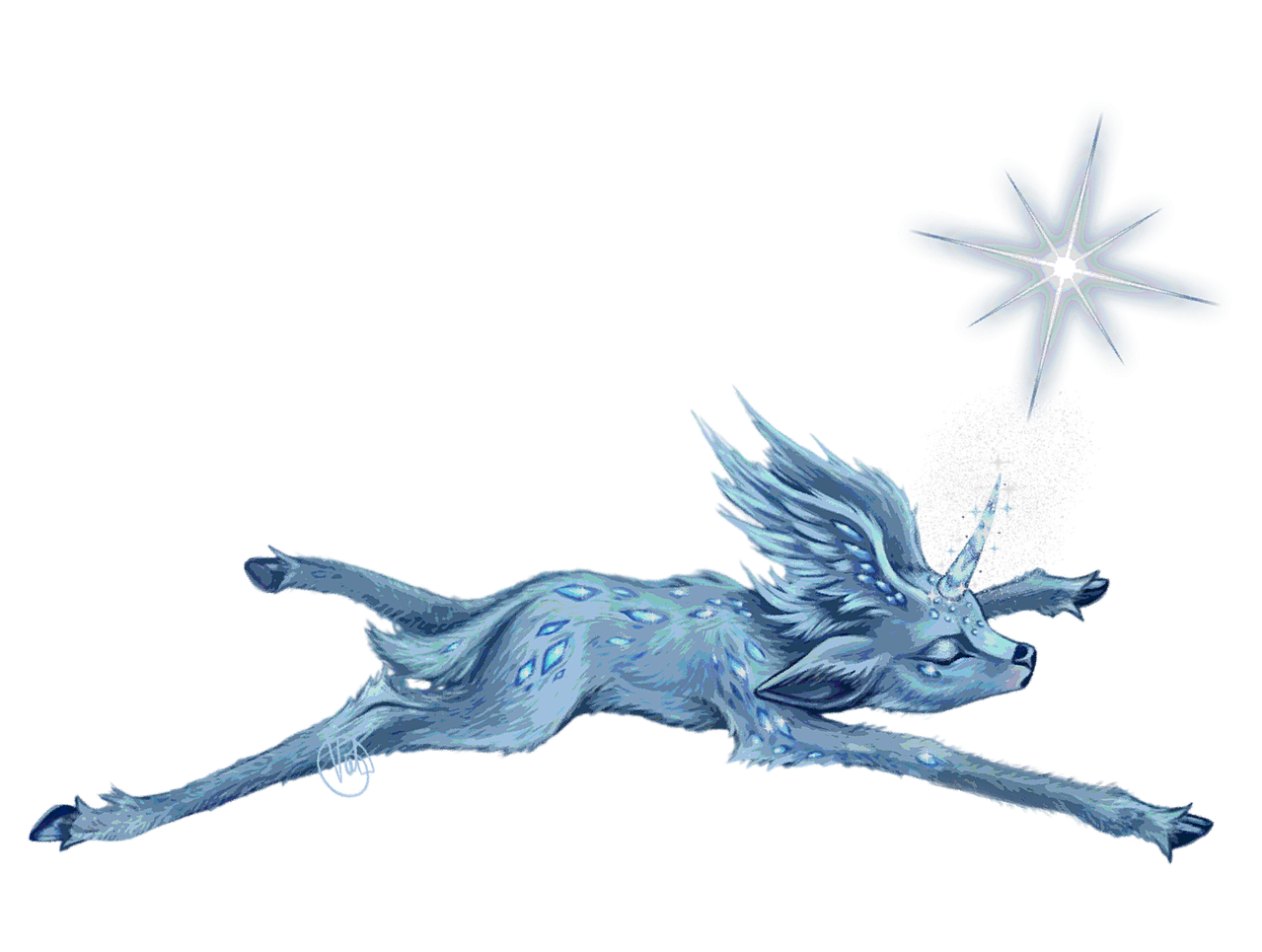
death did not keep Amalthea . there are forests through which people walk. and there is the forest which walks through people. the endless forest, made of all northern thickets at once. there ancient pines and other majestic trees remember everyone who died before their time. there the moss glows from within, as if drowned stars lay underneath. there rivers sometimes flow uphill, and the wind carries not the smell of resin but voices. there Amalthea opened her eyes again. she was a tiny thing, a small soft creature on trembling thin legs. a fawn. a fluffy round ball the color of sky blue, that same shade shadows have on snow at the clearest northern noon. so small she could have fit into the palms of a grown man. instead of horns, two small wings rose from her head, blue like her fur but darker, closer to the color of a winter night. the wings were stiff, made of small feathers, not built for flight. in each of them, between the feathers, sat several transparent, sharp crystals. her frozen tears. the forest had not thrown them away, the forest had woven them into her new body. on the back of her head grew a soft crest of longer feathers, also blue, trembling faintly even without wind. along her back, her thin neck, her sides, and to the very tip of her short tail these same crystals were scattered, small as drops of morning dew frozen in july. they glowed from within with a soft, steady light, and when the fawn breathed in, they flickered brighter. her eyes remained the same. grey-blue, the color of northern twilight, with the crystal clarity that once frightened the village old women. she did not stand up right away. she wobbled, and the forest accepted her. in the endless thicket live creatures the northern tales call by different names. the mistress of roots. the shepherd of fog. the blind vixens that see memory. huge owls whose pupils are thin rings of hoarfrost. all of them came up to the small fawn, looked at the crystals in her wings, listened to how they rang with every movement, and silently bowed their heads. but the forest does not only accept. the forest judges. into the endless thicket sometimes seep unclean beings. not animals, animals are always pure. but those things that come with rot inside. witches' changelings. hungry shadows of murderers. human souls so stained that after death they found no place in the sky or in the earth. when such a being comes near the small blue fawn, something happens that no other magic in this world can do. Amalthea just looks at it. the crest on her head lifts, the crystals on her body ignite with a soft white light, and the little wings on her head open slightly. at that very moment the creature, no matter how huge or terrible, lifts off the ground. slowly, silently. it rises one elbow, two, three above the moss. no higher. and hangs there. and starts to suffocate. there is no water around. no lake, no river, no swamp. only dry forest air smelling of resin and lingonberries. but the creature suffocates as if shoved headfirst into the thickest, blackest, most icy water of deaf lake. it grabs at empty air with its mouth, but the air does not come in. something invisible closes the throat, presses on the chest from outside. the creature thrashes, twists, claws at its own nothing works. no spell helps. no ancient power fires. an amulet crumbles to dust. the black word sticks in the throat and does not sound. no superpower, no teaching, no school of secret magic can do anything against what the gods gave the small fawn. because the gods did not give her a power. the gods gave her a right. the right of one single soul whose life was cut off meanly and hideously to judge everyone who comes with the same rot. the creature hangs and dies. usually it takes a few minutes. amalthea watches calmly, without anger. she blinks slowly, like an ordinary little fawn. when it is done, the body drops softly onto the moss. the crystals dim, the crest lies back down, and she turns and walks off between the giant pines and other majestic trees, silently, only her tears in her wings ringing faintly, like a distant little bell.
about Agna, the village later told different stories. that she outlived her sister only by a couple of years. that she dried up faster, stopped leaving her hut, screamed at night begging someone not to look at her. that one morning she was found on her own threshold, blue in the face, mouth open, as if she had suffocated, though the air around was only clean and frosty. and that on her cheeks, near her eyes, two small transparent drops had frozen, hard as glass. the old people saw this, crossed themselves silently, and did not bury her in the common cemetery. she was buried outside the village, at the edge of the woods, and the place was left unmarked.
❅ when Amalthea first reincarnated in the forest, one of the largest frozen tears detached from her wing and fell onto the moss. using thin, tough roots of taiga grass, the little fawn wove a sort of necklace from them and secured the crystal to herself. this blue stone became her first magical focus. it was through it that Amalthea began to understand the laws of the Endless Forest. thanks to the crystal, she gained the ability to lift objects into the air and manipulate them telekinetically in any way she wished with the power of her mind she could move heavy boulders, stop falling trees, or weave branches into shelters. this same crystal helped her learn to transform into an arctic fox and cross the threshold of the forest to visit her home, if only for a little while.
❅ since Amalthea is now a creature of pure light and cold, her breath in the frosty taiga air looks different from that of living beasts. when she exhales, it is not just a white cloud of steam that escapes her mouth. her breath is a tiny, ephemeral northern light. thin emerald, lilac, and pale blue flashes dance in the air for a few seconds before melting away. these glowing clouds sometimes settle on branches, illuminating the forest with a dim magical light.
❅ where the blue fawn walks, the earth, grass, and roots are instantly encased in ice. but this is not the dead, cruel cold that killed her in the lake. her ice does not kill living things, it preserves them. if a fading flower, a leaf falling from a branch, or even a wounded small bird falls into the zone of her frost trail, time stops for them. they freeze in a perfect crystal stasis, feeling no pain and not decaying. Amalthea forged the cold into a shield. when the ice eventually melts, the preserved life continues from that exact moment, healed and untouched by death.
❅Amalthea no longer needs words to be heard. the forest granted her the absolute gift of telepathy. she is able to communicate with any living creature on the level of thoughts, bypassing language barriers. to a frightened animal or a lost traveler, her telepathic voice sounds inside their head like a calming, quiet chime of crystal or a gentle whisper that drives away fear. she can transmit complex mental images, project a map of a safe path through the thicket directly into someone's consciousness, or soothe panicking minds from many miles away just by reaching out with her mind.
❅ the heavy, concentrated magic of the blue fawn is permanently tied to the Endless Forest. in this divine body, she cannot go out to humans. to cross the boundary, Amalthea uses her blue crystal. she channels her accumulated power into it, summoning a localized snowstorm that wraps her in a dense cocoon. inside this icy vortex, she compresses her spiritual essence, hiding her wings and divine light. when the snow settles, only a small arctic fox remains on the ground. this transformation is a complex magical process, a bridge between the spirit world and the world of her past.
❅ in the body of the fox, she looks almost like an ordinary forest animal, but with mystical differences. her fur is absolutely white, but on her chest it is bluish-white, and this deep blue hue shimmers quietly in the twilight. on her left front paw is tightly tied that same handmade root necklace with the blue crystal tear. her eyes remained the same grey-blue, frighteningly clear, with a crystal gleam at the bottom. it is the gaze of a creature that knows the secrets of life and death, locked inside the body of a small predator.
❅the most important miracle of Amalthea lies not in her supernatural abilities, but in her soul. the horrific betrayal by a loved one and the agonizing death at the bottom of the black lake could have easily turned her into a vengeful, embittered ghost, cursing all living things. but her gentle, kind heart did not break from the evil she witnessed. in the Endless Forest, she became the embodiment of pure white, light magic. she does not sow darkness, does not feed on fear, and does not seek revenge (her judgment over rotten souls is a mechanism of protecting the world, not her personal malice). her entire essence is directed towards creation, healing, and mercy, proving that even the blackest human filth cannot corrupt true light.





notes from the bodleian /
three faces, one red mess
june 13, 2026i've been staring at this sketch for two hours instead of finishing my essay on beowulf. a three-headed stag. it's such a messy, brilliant piece of mythology. as a philologist, i'm trained to look for the root, the 'logos', but here the root is split. three necks, three faces, three distinct ways to perceive the world.
funny thing, i actually remembered that photo from 2014. renatas jakaitis caught a shot of deer standing so close together they looked like one creature with three heads. everyone laughed and shared it around. but looking at it now, after staring at this sketch, that photo doesn't feel like an accident anymore.
i keep thinking: does the deer even want to know where these paths lead, or is it just tired of carrying the weight? i'm supposed to analyze the narrative, but i just want to touch those red strings and see if they're warm.
and that red sphere... it's not a halo. it's a knot of threads, heavy and tangled, just hanging there over the antlers. it's the morphology of fate - red, jagged, and absolutely exhausted. three paths, three faces. a tangled story that doesn't want to be read, just carried. i should be studying, but i can't stop thinking about how heavy that red knot must be.
notes from the bodleian /
the pub theory
june 27, 2026went out with some coursemates tonight. we ended up in that tiny pub near the river, the one with the crooked floor. after the third pint i started talking about the deer. bad idea probably. tom said it sounds like cerberus but for indecisive people. anna said i'm reading too much into it.
but then she paused and said wait, three heads, isn't that just us? like right now? she pointed at me, herself, and tom. three people, one table, one evening, completely different lives tangled up for a couple of hours over cheap beer. and when we leave we take a bit of each other's thread with us.
that's the red knot isn't it. it's not mythological at all. it's tuesday night in oxford and we're all just "deer" pretending we know which way to walk home.
Do u rly think that someone
No matter how hard you try to present yourself differently u are imprinted as someone ill-mannered, incapable and unwilling to handle emotional strain
notes from the bodleian /
half a sandwich
june 28, 2026tried to do laundry today. that was the whole plan, wake up, do laundry, maybe eat something. i managed the first two. the washing machine in the basement makes this rattling sound that i used to find annoying but now it's kind of the only thing keeping me anchored. i sat on the floor next to it for forty minutes just watching my clothes spin. that's when i realized it's back. i wanted to pull my knees up to my chest and hold them tight and cry a little, quietly, the way you cry when there's no one around to hear. but there wasn't even that in me. no tears, no shake, nothing. just the hum of the machine and my own breathing, and the strange feeling that i was watching myself from somewhere near the ceiling. that's the part that frightens me. not the crying, the not being able to.
ate half a sandwich afterwards. cheese and pickle from the corner shop. i'm writing this down because someone once told me you should track the small wins when things get bad again. half a sandwich. i couldn't tell you what it tasted like. the closest i've got to naming it all evening is this - the world became a translation of itself. like everything is happening in a language i used to be fluent in and now i can only catch every third word. i had eight months. eight good months of being a person. and i really thought that was it, that i'd somehow walked far enough away from it.
that's the joke of remission, isn't it. it lets you forget, and forgetting makes it worse when it comes back. still. half a sandwich. the essay is due friday. my mother thinks i'm fine. the fog thinks otherwise.
notes from the bodleian /
the wrong bus
july 1, 2026got on the wrong bus today and instead of correcting it i just let it take me somewhere. ended up in a part of oxford i've never been to. some quiet residential street with brick houses and cats sitting on windowsills. i walked for an hour with no plan. no destination. it was the first time in months i wasn't trying to get anywhere. bought a coffee in a small shop where the owner talked to me about the weather like i was any other customer.
small comfort. but comfort.
there's something in flaubert about how great sorrows are silent. i don't remember the exact quote and i'm too tired to look it up. but sitting in that little coffee shop, being nobody to anyone, i understood what he meant for the first time.